

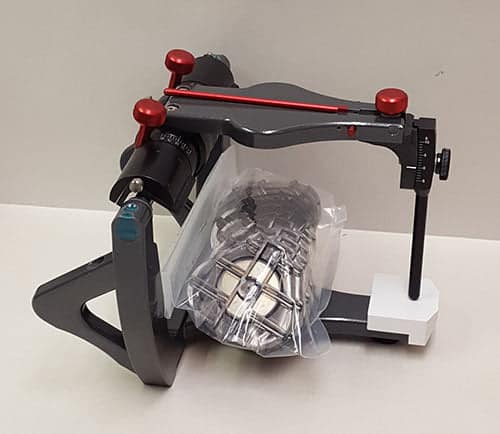
Types of Dental Articulators: Simple Hinge, Semi-Adjustable and Fully Adjustable Compared
The main types of dental articulators are simple hinge (including plasterless and disposable designs), average value or nonadjustable, semi-adjustable, and fully adjustable instruments. Each step up reproduces more of the patient’s jaw movement, so the right choice depends on the case, not just the budget. Chase Dental Supply carries all four classes, including Hanau and Denar instruments from Whip Mix, plus facebows, mounting plates and remount jigs.
Quick Answer
There are four practical types of dental articulators. Simple hinge articulators only open and close. Average value articulators add fixed, average condylar angles. Semi-adjustable articulators, such as the Hanau Wide-Vue or Denar Mark 320, let you set condylar inclination and side shift from patient records. Fully adjustable articulators, such as the Denar D5A, are programmed from pantographic tracings for complex full mouth cases.
Key Takeaways
- Simple hinge and plasterless articulators (Whip Mix MainStay, Hanau Model Mate, Meta Dental #602) suit single units, quadrants, splints and model work.
- Average value articulators, like the Hanau Ulti-Mate with a fixed 30 degree protrusive and 15 degree Bennett angle, cover the average patient without adjustment.
- Semi-adjustable articulators come in arcon (Hanau Wide-Vue, Hanau Modular) and non-arcon (Hanau 96H2) designs.
- The Denar D5A is a fully adjustable, arcon articulator with an intercondylar distance adjustable from 90 to 150 mm.
- A facebow transfer (Hanau Spring-Bow, Slidematic or QuickMount) is what makes adjustable settings meaningful.
What Is a Dental Articulator?
A dental articulator is a mechanical device that holds the maxillary and mandibular casts in a fixed relationship and simulates jaw movement. Technicians and dentists use it to set teeth, wax restorations and check occlusal contacts outside the mouth.
The more accurately an articulator copies the patient’s temporomandibular joint, the fewer chairside adjustments a crown, bridge or denture needs.
What Are the Types of Dental Articulators?
The types of dental articulators fall into four classes based on how much jaw movement they can reproduce.
1. Simple Hinge, Plasterless and Disposable Articulators
A simple hinge articulator opens and closes on a single axis and does not reproduce lateral or protrusive movement. It is fast, inexpensive and ideal for single units, quadrant crowns and study models.
The Whip Mix MainStay Disposable Articulator System Quadrant Pinless needs no model formers or gypsum base, and its flat base has no external walls, so dies and segments seat without interference. Pin versions come in full arch, anterior and quadrant sizes.
The Meta Dental Corp Articulators #602 line includes brass and chrome crown and bridge, high arch and low arch denture articulators, plus disposable plastic and magnetic options. The Ray Foster Apex #2 Articulator is 45 mm wide at the joint with a 25 degree condylar inclination. Plasterless designs such as the Hanau Model Mate and the ENZO Universal Articulator skip the mounting stone entirely.

2. Average Value (Nonadjustable) Articulators
An average value articulator has condylar guidance fixed at angles that represent the average patient. It moves in protrusive and lateral excursions, but you cannot change the settings.
The Hanau Ulti-Mate Articulator has a fixed 30 degree protrusive angle, a built-in 15 degree Bennett angle and magnetized fossae. The Denar Mark 310 Articulator is set at 25 degrees protrusive condylar inclination and 15 degrees progressive side shift for routine restorative work.
3. Semi-Adjustable Articulators: Arcon vs Non-Arcon
A semi-adjustable articulator lets you set condylar inclination and side shift (Bennett movement) from a facebow transfer and interocclusal records. It is the workhorse class for crown and bridge, removable prosthodontics and dental schools.
In an arcon articulator, the condylar guidances sit on the upper member and the condyles on the lower member, just like the skull and mandible. In a non-arcon articulator, the guidances are on the lower member.
- Arcon: the Hanau Wide-Vue Articulator, Arcon 183-2 offers open lingual visibility, and the Hanau Modular Articulator family uses interchangeable components with condylar inclination adjustable from 0 to 90 degrees.
- Non-arcon: the Hanau 96H2 Semi-Adjustable Articulator has enclosed guidances that keep the condylar element from lifting during waxing.
- Denar: the Denar Mark II Articulator adds adjustable immediate side shift from 0 to 4 mm, and the Denar Mark 320 works with the Slidematic facebow.
- Whip Mix: the Whip Mix Model 2240Q has over 4 inches of interframe spacing, and the Whip Mix Model 4641 adds tracking fossae.
Need Help Matching an Articulator to Your Cases?
Tell us what your lab or practice builds and we will point you to the right Hanau, Denar or Whip Mix instrument. Call for current pricing.
4. Fully Adjustable Articulators
A fully adjustable articulator can be programmed to follow an individual patient’s condylar path, usually recorded with a pantograph. It is used for full mouth rehabilitation, complex occlusal schemes and advanced prosthodontic training.
The Denar D5A Fully Adjustable Articulator has independently adjustable fossae walls and arcon construction. Removable medial and superior wall inserts allow custom grinding, and the intercondylar distance adjusts from 90 to 150 mm.

Hanau vs Denar vs Whip Mix vs Meta Dental: How Do They Compare?
Hanau and Denar instruments are both sold under Whip Mix and share many facebows and accessories. The table compares listed specifications only.
| Articulator | Class | Condylar / Protrusive | Side Shift / Bennett | Intercondylar |
|---|---|---|---|---|
| Hanau Wide-Vue 183-2 | Semi-adjustable, arcon | Minus 20 to 60 degrees | Bennett 0 to 30 degrees | See product page |
| Hanau 96H2 | Semi-adjustable, non-arcon | 0 to 75 degrees | Lateral 0 to 30 degrees | Fixed 110 mm |
| Denar Mark 320 | Semi-adjustable | 0 to 60 degrees | Progressive fixed at 15 degrees | See product page |
| Denar D5A | Fully adjustable, arcon | 0 to 60 degrees | Immediate 0 to 4 mm, progressive 0 to 30 degrees | Adjustable 90 to 150 mm |
| Whip Mix 2240Q | Semi-adjustable | Adjustable, curved eminentia | Immediate side shift | Fixed 110 mm |
| Whip Mix 4641 | Semi-adjustable, tracking fossae | Adjustable | Progressive side shift | Fixed 110 mm |
| Meta Dental #602 | Simple and disposable lab articulators | Not adjustable | Not applicable | Brass, chrome, plastic and magnetic styles |
For a deeper look at individual Hanau and Whip Mix models, see our Hanau and Whip Mix Articulators Buyer’s Guide.
Why Does a Facebow Matter?
A facebow records the position of the maxillary arch relative to the skull and transfers it to the articulator. Without it, a semi-adjustable articulator’s condylar settings are applied to a cast that sits in an arbitrary position, which wastes much of the instrument’s accuracy.
- Earpiece facebow: the Hanau Spring-Bow Earpiece Facebow (Complete) records the maxillary arch relative to the external auditory meatus. It mounts to all Hanau and Denar articulators except the Hanau Model 145.
- Slidematic: the Denar Slidematic Facebow with Quick Lock Toggle System uses a detachable transfer jig and fits most Denar, Hanau and Whip Mix articulators.
- Whip Mix and QuickMount: the Whip Mix Indirect Mounting Facebow #9185 serves the 2000, 3000 and 4000 Series. The QuickMount magnetic system is covered in our Whip Mix QuickMount Facebow guide.

What About Mounting Plates and Remount Jigs?
Mounting plates let you remove mounted casts and return them to the same articulator, or to a matched one, without remounting. Remount jigs preserve the facebow relationship so finished dentures can be remounted and adjusted.
Converter Plates for Whip Mix Articulators add magnetic retention to all Whip Mix articulators, and the QuickMount Plate Holder 13MM fits Whip Mix, Hanau Modular and Denar upper members, with lower member fit listed on the product page. The QuickMount Remounting Jig temporarily replaces the mandibular cast and plate, which eliminates a second facebow recording when remounting finished dentures. The Remounting Record Jig 158-51 serves the same purpose for upper models after processing.
For plastic articulators, Meta Dental Corp Model Base Formers create a consistent base. Mounting stone choice matters too, as explained in our flasking stone vs mounting stone guide.
Which Articulator Should You Choose?
Choose by the work you do most often, then add a facebow and mounting system that fits that articulator.
- High volume crown and bridge labs: MainStay or Meta Dental #602 for single units and quadrants, plus a semi-adjustable instrument for multi-unit cases.
- Removable and denture labs: a Hanau Wide-Vue, Hanau 96H2 or Whip Mix 4641 plus a remount jig.
- General dentists: the Denar Mark 320 with the Slidematic, or the Whip Mix 2240Q with magnetic plates.
- Dental schools: arcon instruments like the Hanau Wide-Vue or Modular.
- Prosthodontists and complex rehab: the Denar D5A fully adjustable articulator with pantographic records.
- Ortho, splints and case presentations: plasterless options such as the Hanau Model Mate or ENZO Universal Articulator.
Shop the Products


Frequently Asked Questions
What are the four types of dental articulators?
The four types of dental articulators are simple hinge, average value (nonadjustable), semi-adjustable and fully adjustable. Simple hinge articulators only open and close, while each higher class reproduces more of the patient’s condylar movement.
What is the difference between an arcon and a non-arcon articulator?
In an arcon articulator the condylar guidances are attached to the upper member and the condyles to the lower member, matching human anatomy. In a non-arcon articulator the guidances are on the lower member. The Hanau Wide-Vue is arcon; the Hanau 96H2 is non-arcon.
What is a fully adjustable articulator used for?
A fully adjustable articulator is programmed to follow an individual patient’s condylar path, usually recorded with a pantograph. It is used for full mouth rehabilitation and complex occlusal cases, and the Denar D5A is a common example.
Do I need a facebow with a semi-adjustable articulator?
A facebow transfer is recommended because it positions the maxillary cast on the articulator in the same relationship it has to the patient’s skull. The Hanau Spring-Bow and Denar Slidematic both transfer to Hanau and Denar articulators.
Are Hanau and Denar articulators made by the same company?
Yes. Hanau and Denar articulators and facebows are both sold under Whip Mix, along with Whip Mix’s own models such as the 2240Q and 4641. Many facebows and mounting accessories work across the three lines; check each product page for compatibility.
Related Guides
Most labs own more than one type of articulator. Chase Dental Supply carries the full Whip Mix range of Hanau, Denar and Whip Mix instruments along with Meta Dental, Ray Foster and ENZO articulators. Email sales@chasedentalsupply.com or call for current pricing and compatibility questions.
Build Your Articulator and Facebow Setup
From disposable MainStay articulators to the Denar D5A, we can help you match articulators, facebows and mounting plates. Call for current pricing.




Leave a Reply