


Meta Dental Lab Micromotors: Brushless vs Brushed and the Marathon Line
The best dental lab micromotor for most technicians is the one whose speed, torque and foot control match the materials you cut every day, and Meta Dental Corp covers that range with brushed Marathon units, brushless ECO-1000, HANDY 700 and MULTI 600 models, and a battery powered portable. Chase Dental Supply carries the full Meta Dental Corp lab equipment line, so you can compare models side by side and order the right control box and handpiece together.
This guide explains how brushless and brushed micromotors differ, walks through the Marathon models using the published specs, and shows where the Air Turbo and LS200 spindle fit in a busy lab.
Quick Answer
A dental lab micromotor is an electric motor and control box that drives a straight handpiece for trimming, grinding and finishing. Brushed Marathon units such as the Champion (40,000 RPM, 2.9 Ncm) and N7R (45,000 RPM, 4.5 Ncm) suit general lab work, while brushless models like the ECO-1000 reduce brush maintenance. Chase Dental Supply carries both types.
Key Takeaways
- The Marathon Champion is the entry unit: 40,000 RPM, 2.9 Ncm torque, 45W output and an on/off foot pedal.
- The Marathon BesQual 2 adds a variable FS60N foot pedal and overload protection at 100W output.
- The Marathon N7R and N1 step up to 45,000 RPM, 4.5 Ncm torque and 140W for heavier alloy and acrylic work.
- Brushless ECO-1000, HANDY 700 and MULTI 600 units run on 110V to 120V and avoid carbon brush wear.
- The Marathon Combi is battery powered at 25,000 RPM for off site and on the go jobs.
What is a dental lab micromotor?
A dental lab micromotor is a bench top system made of a control box, a motor handpiece and a foot control that spins rotary instruments for cutting and finishing. Technicians use it to trim acrylic dentures, adjust metal frameworks, contour crowns and finish models.
The two numbers that matter most are maximum speed in RPM and torque in Ncm. Speed helps with fine finishing on ceramics and composites, while torque keeps the bur turning under load when you grind chrome cobalt or bulk reduce acrylic.
Foot control is the third decision. An on/off pedal runs the motor at the speed set on the dial, while a variable pedal lets you feather speed with your foot without taking your hands off the work.
Brushless vs brushed micromotors: what is the difference?
A brushed micromotor uses carbon brushes to carry current to the spinning armature, and those brushes wear over time and eventually need replacement. A brushless micromotor uses electronic switching instead, so there are no brushes to wear out.
In practice, brushless motors are generally chosen by labs that run handpieces for long shifts and want less routine service. Brushed units remain popular because they are simple, proven and widely serviceable.
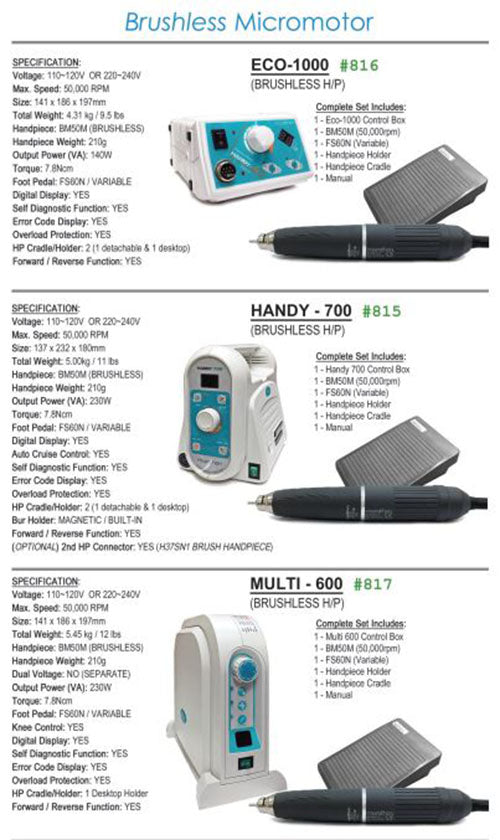
Meta brushless options: ECO-1000, HANDY 700 and MULTI 600
Meta offers three brushless micromotors with handpiece: the ECO-1000, HANDY 700 and MULTI 600, each rated for 110V to 120V. Check the product page or call our team for the speed and torque of each model before you order.
When a brushed Marathon still makes sense
If your lab already stocks Marathon handpieces and foot pedals, staying with a brushed Marathon control box keeps parts interchangeable. The published specs below make it easy to match a unit to your workload.
Which Marathon micromotor should I choose?
Choose the Champion for light trimming and student benches, the BesQual 2 when you want variable speed and overload protection, and the N7R or N1 when you need more torque. All four ship with a control box, handpiece or motor, foot switch, handpiece holder, cradle and manual.
| Model | Max speed | Torque | Output | Foot pedal | Overload protection |
|---|---|---|---|---|---|
| Marathon Champion | 40,000 RPM | 2.9 Ncm | 45W | On/Off | No |
| Marathon BesQual 2 | 40,000 RPM | 2.9 Ncm | 100W | Variable (FS60N) | Yes |
| Marathon N7R | 45,000 RPM | 4.5 Ncm | 140W | Variable (FS60N) | Yes |
| Marathon N1 | 45,000 RPM | 4.5 Ncm | 140W | See product page | See product page |
| Marathon Combi Portable | 25,000 RPM | See product page | Battery powered (Ni-MH) | On/Off | See product page |
Marathon Champion
The Champion is a compact control box (165 x 114 x 76mm, 6 lbs total) with a dual voltage switch, a forward/reverse switch and a bur holder. It is a sensible first motor for a new technician or a teaching lab.
Marathon BesQual 2
The BesQual 2 keeps the 40,000 RPM ceiling but raises output to 100W and adds overload protection plus the FS60N variable pedal. That combination gives finer control on delicate margins.
Marathon N7R and N1
The N7R and N1 both reach 45,000 RPM with 4.5 Ncm of torque and 140W output. The N1 has a dual voltage switch, while the N7R is single voltage and does not include a bur holder.
Not sure which Marathon fits your bench?
Tell us what you cut most and we will help you match speed, torque and pedal type to your work.
Which micromotor handpiece do I need?
Match the handpiece to your control box and your heaviest task. Meta sells Marathon micromotor handpieces individually, so you can add a spare or move up in torque without replacing the whole system.
- SH37SN: 45,000 rpm, 4.5 Ncm, 220g.
- H37SN1, H35SP and H37SP: 40,000 rpm, 2.9 Ncm, 220g each.
- BM50M1: 50,000 rpm, 7.8 Ncm, 260g, the highest torque option listed.
- M33E: 35,000 rpm, 2.4 Ncm, 120g, a light motor handpiece only.
- ES-6: E-type straight nosecone, 40,000 rpm, 55g, autoclavable to 135C (275F).
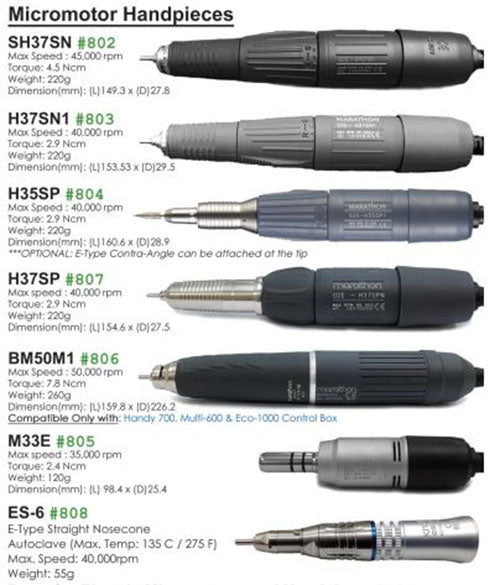
Pair a high torque handpiece with a control box that can deliver it. The SH37SN, for example, lines up with the 4.5 Ncm rating of the N7R and N1 control boxes.
Do I need a portable or air driven unit?
You need a portable unit if you adjust appliances away from the bench, and an air turbine if you finish a lot of zirconia and ceramics. Meta covers both cases.
Marathon Combi Portable
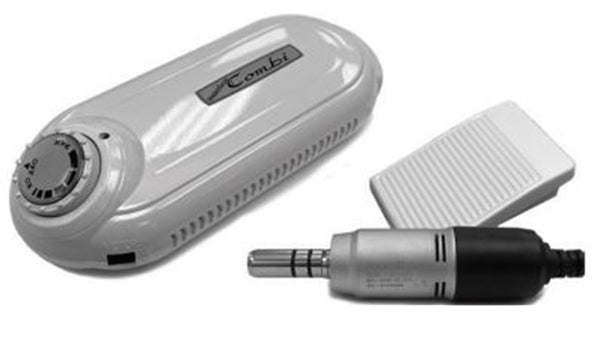
The Marathon Combi Portable Unit is a battery operated micromotor running at 25,000 rpm on a rechargeable Ni-MH battery, with a listed 140 hours of work time. The set includes the control unit with M25E E-type motor, on/off foot control, handpiece holder, AC adapter, carrying case and waist strap pouch.

Marathon Air Turbo
The Marathon Air Turbo Unit is a high speed laboratory handpiece designed for zirconia based ceramics and other ceramics. The AT300W water version adds spray to control heat and help prevent cracks, and both versions include an air regulator, handpiece, lubricating oil and foot pedal.
An air turbine needs a clean, dry air supply. If you are planning a compressor, our guide to sizing TPC Superb Air oil-less compressors covers the basics.
LS200 High Speed Spindle
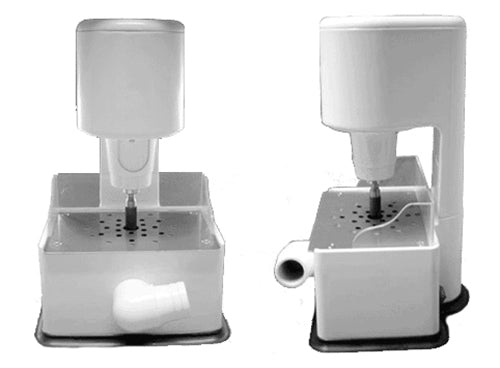
For bench grinding with lab alloy grinders, the LS200 High Speed Spindle reaches 30,000 RPM and measures 38mm by 153mm at 820g. It is an automatic spindle rather than a handheld motor.
How do you keep a lab micromotor running well?
Keep the handpiece clean, use straight shank burs that are fully seated, and follow the manufacturer’s instructions for use on lubrication and service. Do not run a brushed motor at full load for long periods without breaks.
Use the right abrasive for each material so the motor is not fighting the bur. Our guide to Meta polishers, mounted stones and diamond discs matches stones and polishers to porcelain, alloys and acrylic.
For a wider view of the equipment brands we stock, see the dental lab and office supply brands guide.
Shop the Products

Frequently Asked Questions
What is the difference between a brushless and a brushed dental micromotor?
A brushed micromotor uses carbon brushes that wear over time and need periodic replacement. A brushless micromotor uses electronic switching, so there are no brushes to wear out. Meta Dental Corp offers brushed Marathon units and brushless ECO-1000, HANDY 700 and MULTI 600 models.
How fast is the Marathon Champion micromotor?
The Meta Dental Corp Marathon Champion has a maximum speed of 40,000 RPM with 2.9 Ncm of torque and 45W output. It uses an on/off foot pedal and includes a dual voltage switch, forward/reverse switch and bur holder.
Which Marathon micromotor has the most torque?
Among the Marathon control boxes, the N7R and N1 list 4.5 Ncm of torque at up to 45,000 RPM with 140W output. For handpieces, the BM50M1 lists 7.8 Ncm at 50,000 rpm.
Is there a portable micromotor for off site lab work?
Yes. The Meta Dental Corp Marathon Combi Portable Unit is battery operated, runs at 25,000 rpm and uses a rechargeable Ni-MH battery. It comes with an M25E E-type motor, foot control, AC adapter, carrying case and waist strap pouch.
Which Meta handpiece is designed for zirconia?
The Meta Dental Corp Marathon Air Turbo is a high speed laboratory handpiece designed for zirconia based ceramics and other ceramics. It comes in an air version (AT300A) and a water spray version (AT300W) that helps control heat.
Related Guides
A good micromotor pays for itself in cleaner margins and less hand fatigue. Browse the full Meta Dental Corp collection at Chase Dental Supply, or reach our team at 888-548-7582 or sales@chasedentalsupply.com for help choosing a control box and handpiece.
Ready to upgrade your lab micromotor?
Shop Marathon, brushless and portable units from Meta Dental Corp, or call us for a recommendation.



Leave a Reply