


Dri-Angles Plain vs Silver: Sizes, Pack Counts and When to Use Each
Plain Dri-Angles and Silver Dri-Angles do the same basic job: they absorb saliva at the parotid duct so you can keep a posterior field dry. The difference is that Silver Dri-Angles have a silver coating on one side that acts as a moisture barrier for heavy salivators. Chase Dental Supply carries both, plus a 200/pk small plain option, in our Consumables category.
Quick Answer
Dri-Angles are thin, absorbent cellulose triangles placed on the cheek over the parotid duct opening to control saliva in place of a cotton roll. Choose Plain Dri-Angles for routine isolation. Choose Silver Coated Dri-Angles for heavy salivators, since the silver coating on one side acts as a moisture barrier.
Key Takeaways
- Dri-Angles are thin absorbent cellulose triangles designed as a replacement for cotton rolls in the parotid area.
- Silver Coated Dri-Angles add a silver coating on one side that the manufacturer describes as a complete moisture barrier for heavy salivators.
- Pack options include Small 400/pk, Large 320/pk and Assorted (200 small and 160 large), in plain or silver coated.
- A separate Dri-Angle Small Plain 200/pk is available as a smaller box.
- Common uses include sealants, bonding, orthodontic bracket bonding and general posterior isolation.
Dri-Angles Plain vs Silver at a Glance
Both variable listings offer plain and silver coated options, so you can order either type from either page.
| Product | Coating | Pack options | Best for |
|---|---|---|---|
| Dri-Angles Plain (31-S, 31-L, 31-A) | None, absorbent cellulose | Small 400/pk, Large 320/pk, Assorted 200 S and 160 L | Routine isolation, normal saliva flow |
| Dri-Angles Silver Coated (32-S, 32-L, 32-A) | Silver coating on one side | Small 400/pk, Large 320/pk, Assorted 200 S and 160 L | Heavy salivators |
| Dri-Angle Small Plain 200/pk (31S) | None | Small 200/pk | Lower volume use, trying Dri-Angles for the first time |
What Are Dri-Angles?
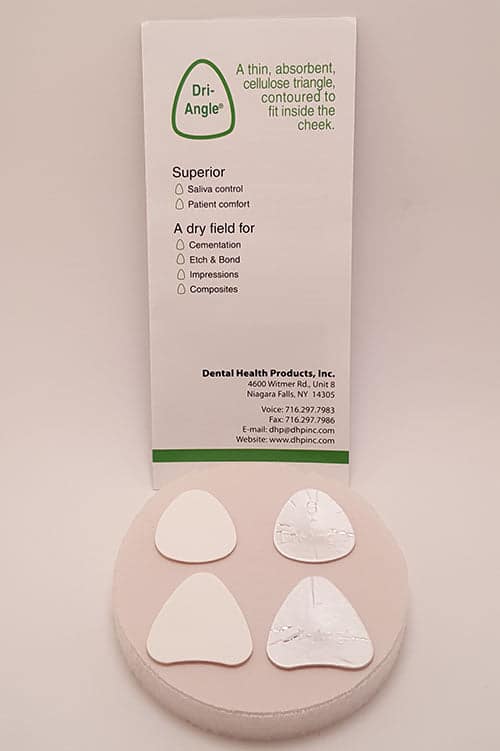
Dri-Angles are thin, disposable, absorbent cellulose triangles used as a replacement for cotton rolls in the parotid area of the mouth. They are placed on the buccal mucosa over the opening of the parotid (Stensen’s) duct, which sits on the inner cheek near the maxillary molars.
Because the parotid gland is a major source of saliva, covering its duct opening slows the flow that would otherwise reach the teeth. The product description for plain Dri-Angles says they effectively restrict the flow of saliva.
Many buyers search for “cotton dry angles,” but the Dri-Angles at Chase are described as cellulose, not cotton. Their thin profile sits flat against the cheek.
What Is the Difference Between Plain and Silver Dri-Angles?
Plain Dri-Angles are uncoated absorbent cellulose. Silver Dri-Angles have a silver coating on one side that the manufacturer says acts as a complete moisture barrier for heavy salivators.
Both types are thin, disposable cellulose triangles placed the same way. If a patient soaks through a plain Dri-Angle quickly, the silver version is the logical next step.
Keep Both Types in the Operatory
Stock plain Dri-Angles for routine cases and silver for heavy salivators. Call for current pricing.
Which Dri-Angle Size and Pack Should You Buy?
Small Dri-Angles suit children and smaller mouths, while large Dri-Angles cover more cheek area in adults. The Assorted pack gives you both sizes in one box.
- Small: 400/pk in plain (31-S) or silver coated (32-S).
- Large: 320/pk in plain (31-L) or silver coated (32-L).
- Assorted: 200 small and 160 large in plain (31-A) or silver coated (32-A).
- Small Plain 200/pk: a half-size box of small plain Dri-Angles (31S).
Not sure which size fits your patient mix? Our team can help you choose before you order.

How Are Dri-Angles Used in Practice?
Dry angles are used wherever a dry posterior field matters. Typical procedures include pit and fissure sealants, adhesive bonding and composite work, and orthodontic bracket bonding.
Place the pad on a dried cheek over the parotid duct opening, then pair it with suction and cotton rolls or other isolation as your technique calls for. For Class II composites, good isolation works hand in hand with your matrix choice; see our guide to Tofflemire matrix bands .001 vs .0015 vs .002.
A dry cellulose pad can cling to the cheek, so many clinicians wet it with water before removal. Follow the manufacturer’s instructions for use for placement and disposal.
Which One Should You Choose?
- Choose Plain Dri-Angles if you are a general practice or hygienist placing sealants on patients with normal saliva flow.
- Choose Silver Coated Dri-Angles if you regularly treat heavy salivators or need a longer dry window for bonding.
- Choose Assorted if your practice sees both children and adults and wants one box for both.
- Choose Small packs if you are a pediatric practice or a school sealant program.
- Choose Silver Large if you are an orthodontic practice bonding brackets on adult molars.
Isolation is one part of infection control and chairside prep. Our comparison of nitrile vs latex vs vinyl dental gloves covers the other side of the tray.
Shop the Products
Frequently Asked Questions
What is a dry angle in dentistry?
A dry angle is a thin, absorbent pad placed on the inner cheek over the parotid duct opening to control saliva during treatment. Dri-Angles are made of cellulose and are used as a replacement for cotton rolls in the parotid area. They are disposable.
Where do you place a Dri-Angle?
A Dri-Angle goes on the buccal mucosa over the opening of the parotid (Stensen’s) duct, on the inner cheek near the maxillary molars. Covering the duct opening limits saliva flow into the posterior field. Follow the manufacturer’s instructions for use for placement.
What does the silver coating on Dri-Angles do?
Silver Coated Dri-Angles have a silver coating on one side that the manufacturer describes as a complete moisture barrier for heavy salivators. Plain Dri-Angles are uncoated absorbent cellulose.
What sizes do Dri-Angles come in?
The Dri-Angles listings at Chase Dental Supply offer Small 400/pk, Large 320/pk and Assorted packs of 200 small and 160 large, in plain or silver coated. A Dri-Angle Small Plain 200/pk is also available.
What procedures are Dri-Angles used for?
Dri-Angles are used when a dry posterior field is needed, such as pit and fissure sealants, adhesive bonding, composite restorations and orthodontic bracket bonding. They are typically combined with suction and other isolation methods.
Related Guides
For most patients, Plain Dri-Angles handle saliva control well, and Silver Dri-Angles are the upgrade when a patient soaks through. Find both, along with other chairside supplies, in the Chase Dental Supply Consumables category, or email sales@chasedentalsupply.com to place an order.
Order Dri-Angles Today
Plain, silver coated, small, large or assorted. Our team can help you pick the right pack.







Leave a Reply