


Types of Dental Handpieces: High Speed, Low Speed, Micromotor and Lab Handpieces
The main types of dental handpieces are high speed air turbines, low speed handpieces (straight nose, contra angle and prophy angles), electric micromotor handpieces, and lab air turbines. Chase Dental Supply carries all of them in its Handpieces and Instruments department, including clinical handpieces from TPC and lab micromotors from Meta Dental Corp.
Quick Answer
There are four main types of dental handpieces. High speed air turbines cut tooth structure at very high RPM with water spray. Low speed handpieces run straight nose, contra angle and prophy attachments with more torque. Electric micromotor handpieces deliver steady torque and are the standard tool in dental labs. Lab air turbines are high speed handpieces built for adjusting zirconia and ceramics.
Key Takeaways
- High speed air turbines such as the TPC NEXIUS and PREMIUS L series are listed at 380,000 to 420,000 RPM with triple water spray.
- Low speed systems like TPC EXOMUS and INXIMUS pair a motor with interchangeable straight nose and contra angle attachments.
- Lab micromotors run far slower but with steady torque, from 35,000 RPM (TPC) to 50,000 RPM (Handler Syncro/Torque IV).
- Brushless micromotors skip carbon brush changes; brushed models are simpler and usually cost less to buy.
- Disposable prophy angles, such as MARK3 90 degree and 105 degree ContraCare angles, are low speed attachments used once and discarded.
What Are the Types of Dental Handpieces?
A dental handpiece is a powered instrument that spins a bur, disc or attachment. Handpieces are grouped by power source (air or electric) and speed range.
1. High Speed Air Turbine Handpieces
A high speed handpiece is driven by compressed air spinning a small turbine in the head. It is used chairside for cutting tooth structure and relies on water spray to control heat.
The TPC NEXIUS Fixed Back End Series is a non-fiber optic high speed with a push button auto chuck, ceramic ball bearings, triple water spray and a speed range of 380,000 to 420,000 RPM. It comes in standard, mini and pedo heads for 2-hole or 4-hole tubing. For lighted work, the TPC Fiber Optic PREMIUS L Series adds cellular glass optic light and a quick disconnect, with connector options for KaVo, NSK and Star style couplers.

2. Low Speed Handpieces: Straight Nose, Contra Angle and Prophy Angles
A low speed handpiece uses a motor with interchangeable attachments and runs at lower RPM with more torque. Clinicians use it for caries removal, finishing, polishing and adjusting appliances.
- TPC EXOMUS Low Speed Handpiece: 4-hole low speed motor with latch or push button contra angle heads, a 1:1 sheath and a straight nose.
- TPC INXIMUS Low Speed Handpiece: an internal water cooling system with a 4-hole motor, push button contra angle and straight nose.
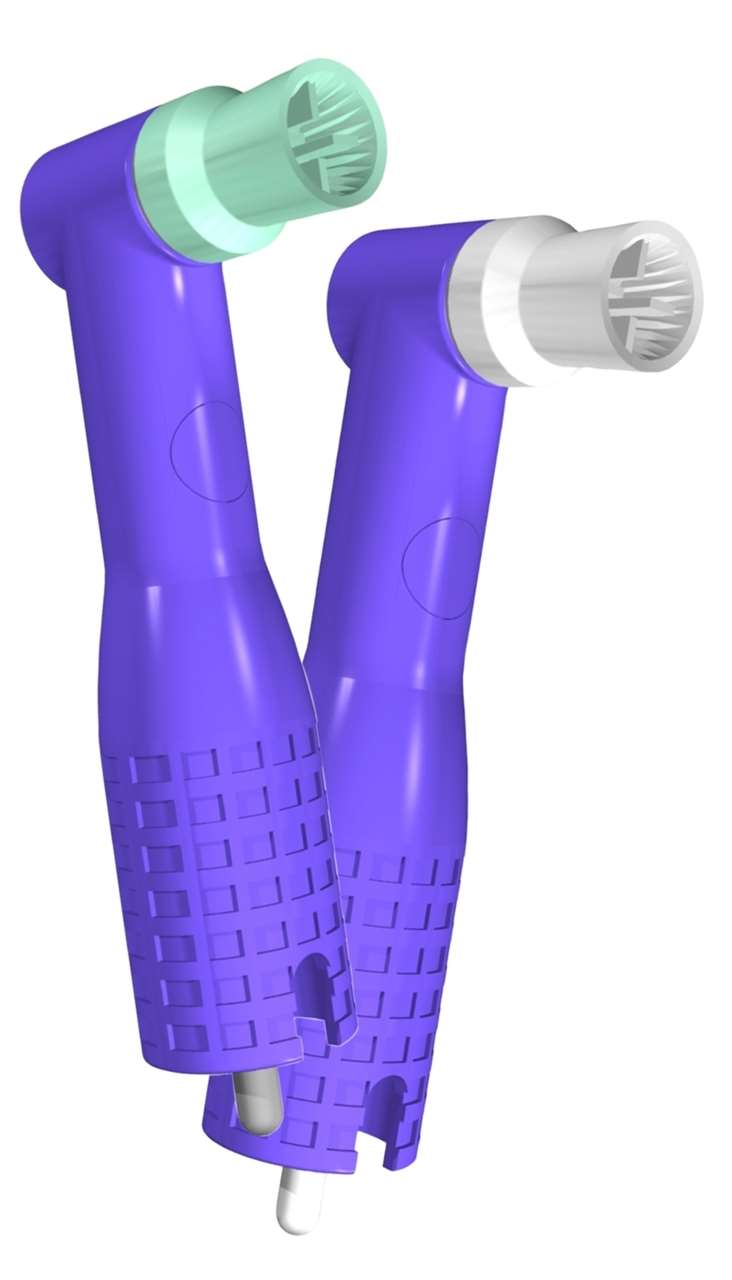
A prophy angle is a low speed attachment that holds a rubber cup for polishing teeth during a cleaning. MARK3 makes MARK3 Disposable Prophy Angles, Soft 90 Degree and a firm cup version with latex-free cups, in boxes of 500 or 144. The MARK3 ContraCare 105 Degree Prophy Angles are inclined at 105 degrees for better access in hard to reach areas. See the full MARK3 line.
3. Electric Micromotor Handpieces
A micromotor handpiece has a small electric motor in the handle, powered by a control box with a foot or knee pedal. It holds torque under load, which is why it is the standard tool for trimming, grinding and finishing in a dental lab.
Clinical electric systems exist for the operatory, but most micromotor buyers are labs. Our Meta Dental lab micromotors guide covers the Marathon line model by model.
- TPC Micromotor and Handpiece: 0 to 35,000 RPM, variable speed foot control, forward and reverse, and automatic stop with alarm and overload reset. An N7 set with a 40,000 RPM E-type motor is also offered.
- Meta Dental Corp Micromotors with Handpieces: the Marathon Champion and BesQual 2 reach 40,000 RPM at 2.9 Ncm, and the Marathon N1 reaches 45,000 RPM at 4.5 Ncm with a variable foot pedal.
- Handler Syncro/Torque 500-IV: a brushless 50,000 RPM handpiece with a digital console, reverse and auto cruise. A 230V version (500-IVE) is also available.
Replacement handpieces are sold separately as Meta Dental Corp Micromotor Handpieces #802, including the SH37SN (45,000 RPM, 4.5 Ncm) and the ES-6 E-type straight nosecone, which is autoclavable to 135C (275F).
Not Sure Which Micromotor Fits Your Lab?
Tell us what you trim, grind and finish, and we will match you to a TPC, Meta Dental or Handler micromotor. Call for current pricing.
4. Lab Air Turbines and High Speed Spindles
A lab air turbine is a high speed, air driven handpiece used at the bench for adjusting hard materials like zirconia. It runs off shop air through a regulator rather than a dental unit.
The Meta Dental Corp Marathon Air Turbo Unit #880 is designed for zirconia based and other ceramics. It comes in air only and air and water versions, and the water spray removes heat that can crack ceramics. Sizing the air supply is covered in our TPC Superb Air compressor guide.
For alloy grinders, the Meta Dental Corp LS200 High Speed Spindle is an automatic spindle rated to 30,000 RPM.

Dental Handpiece Types Compared
The table lists published speed and torque for each product. Where a figure is not listed, call to confirm.
| Handpiece | Type | Max Speed | Torque | Best For |
|---|---|---|---|---|
| TPC NEXIUS | High speed air turbine | 380,000 to 420,000 RPM | Not listed | Chairside cutting |
| TPC EXOMUS | Low speed, 4-hole motor | See product page | Not listed | Contra angle and straight nose work |
| TPC Micromotor | Electric micromotor | 35,000 RPM | Not listed | General lab and chairside adjustments |
| Marathon Champion | Brushed lab micromotor | 40,000 RPM | 2.9 Ncm | Entry level lab benches, schools |
| Marathon N1 | Brushed lab micromotor | 45,000 RPM | 4.5 Ncm | Daily acrylic and model trimming |
| Handler Syncro/Torque IV | Brushless lab micromotor | 50,000 RPM | 713.8 g/cm | High use production benches |
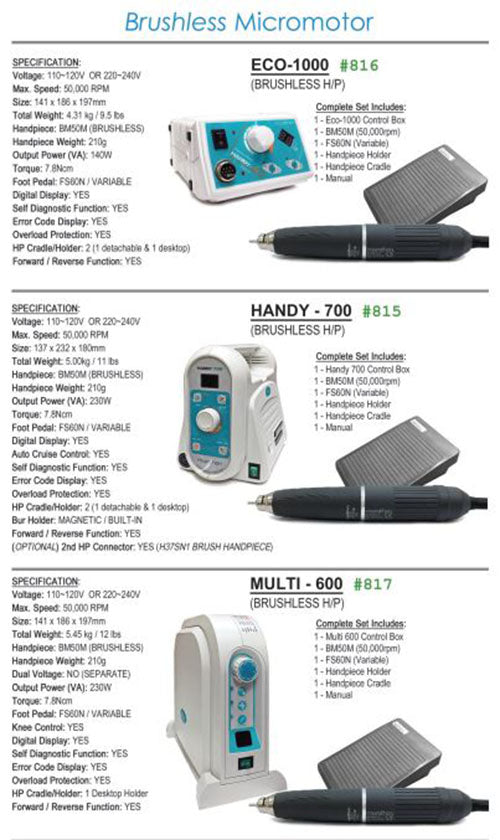
| Meta Dental Brushless (ECO 1000, HANDY 700, MULTI 600) | Brushless lab micromotor | See product page | Not listed | Low maintenance lab work |
| Marathon Air Turbo #880 | Lab air turbine | See product page | Not listed | Zirconia and ceramics |
Brushless vs Brushed Micromotors: What Is the Difference?
A brushed micromotor uses carbon brushes to carry current to the spinning armature, and those brushes wear and must be replaced. A brushless micromotor switches current electronically, so there are no brushes to change.
Brushed sets such as the Marathon N7 list replacement carbon brushes as a separate part. Handler states that the brushless Syncro/Torque IV eliminates the need to change brushes and needs only minimal maintenance if cared for properly. The Meta Dental Corp Brushless Micromotors (ECO 1000, HANDY 700 and MULTI 600) each ship with a BM50M brushless handpiece.
Brushed motors make sense for lighter use or a budget bench. Brushless motors suit labs that run handpieces all day. Pairing either with a Vaniman AutoPilot for 2 Micromotors turns the dust collector on automatically when the motor starts.
How Do You Maintain Dental Handpieces?
Follow the manufacturer’s instructions for use for every handpiece, because cleaning, lubrication and sterilization steps differ by design. The general pattern below applies to most practices and labs.
- Air driven clinical handpieces: clean, lubricate where the IFU calls for it, and sterilize between patients. Run the handpiece briefly after lubricating to clear excess oil.
- Electric micromotors: keep debris out of the chuck and do not oil a motor unless the IFU says to. Replace carbon brushes on brushed motors when performance drops.
- Lab air turbines: use the supplied lubricating oil and keep the air supply dry and clean.
- Disposable prophy angles: use once and discard.
Which Handpiece Should You Choose?
Match the handpiece to the work, and keep a backup.
- General practice: a high speed like the TPC NEXIUS or PREMIUS L plus a low speed set like TPC EXOMUS.
- Pediatric offices: NEXIUS with the pedo head option for smaller mouths.
- Hygiene: MARK3 disposable prophy angles, 90 degree or 105 degree ContraCare. Hygienists choosing ultrasonic inserts can compare frequencies in our 25K vs 30K ultrasonic scaler inserts guide.
- Denture and acrylic labs: a brushed or brushless micromotor such as the Marathon N1 or Handler Syncro/Torque IV.
- Crown, bridge and ceramic labs: a brushless micromotor plus the Marathon Air Turbo for zirconia.
- Schools and new labs: the TPC Micromotor or Marathon Champion for an affordable starting bench.
Shop the Products


Frequently Asked Questions
What are the main types of dental handpieces?
The main types of dental handpieces are high speed air turbines, low speed handpieces with straight nose, contra angle and prophy attachments, electric micromotor handpieces, and lab air turbines.
What is a micromotor handpiece used for?
A micromotor handpiece is an electric handpiece used mainly in dental labs for trimming, grinding, polishing and adjusting acrylic, models and metal. It holds steady torque under load. Lab micromotors at Chase Dental Supply run from 35,000 RPM (TPC) to 50,000 RPM (Handler Syncro/Torque IV).
Is a brushless micromotor better than a brushed one?
A brushless micromotor has no carbon brushes to wear out, so it needs less routine maintenance and suits all day production use. A brushed micromotor is simpler and usually costs less to buy, but its brushes need periodic replacement. Both types are available from Meta Dental Corp.
How fast does a high speed dental handpiece spin?
High speed air turbine handpieces spin far faster than micromotors. The TPC NEXIUS and PREMIUS L series are listed at 380,000 to 420,000 RPM. Actual speed depends on air pressure and load.
What is the difference between a contra angle and a straight handpiece?
A straight nose handpiece holds long shank burs in line with the handle and is used for acrylic, denture and lab adjustments. A contra angle bends the head so the bur reaches intraoral areas, and it accepts latch or friction grip burs depending on the head. Both attach to a low speed motor.
Related Guides
Most offices need a high speed, a low speed and prophy angles; most labs build around a micromotor. Chase Dental Supply carries TPC clinical handpieces, Meta Dental Corp and Handler micromotors, and MARK3 prophy angles. Email sales@chasedentalsupply.com or call for current pricing.
Outfit Your Operatory or Lab Bench
From TPC high speeds to brushless lab micromotors, our team can help you choose. Call for current pricing.




Leave a Reply